Hybrid turbidite–contourite systems in the modern Tarakan Basin: seismic sedimentology and analogue for subsurface storage (Nugraha & Maulin, 2025)

Hybrid turbidite–contourite systems are present where gravity-driven and bottom-current processes interact. Although recent studies have advanced our understanding, deciphering the relative roles of downslope and alongslope processes in shaping the deep seafloor remains an important subject of investigation. The Tarakan Basin, offshore northeastern Borneo, is a prolific hydrocarbon province, yet its modern sedimentary systems are poorly understood. Shaped by rapid deltaic sedimentation, active tectonics, and ocean currents–the South China Sea Throughflow (SCSTF) and Indonesian Throughflow (ITF) – the basin offers an ideal setting to study hybrid deepwater processes. Here, we conducted seismic sedimentology analysis to quantify morphometric parameters, delineate seismic facies, and interpret depositional processes using 3D seismic reflection data. Three segments are identified. The Northern Segment is dominated by upslope-migrating sediment waves and plastered drifts, indicative of contourite-dominated conditions. The Central Segment hosts a canyon–drift complex, formed by synchronous interaction of turbidity flows and bottom currents. In contrast, the Southern Segment is shaped mainly by turbidity currents, with gullies and associated sediment waves suggesting limited bottom current influence. These spatial variations reflect a spectrum of hybrid depositional styles, consistent with global models of contourite-, synchronous-, and turbidite-dominated systems. The sedimentary patterns observed provide an analogue for subsurface reservoir and seal distribution, relevant to both petroleum and carbon storage systems.

Citation: Nugraha HD and Maulin HB (2025) Hybrid turbidite–contourite systems in the modern Tarakan Basin: seismic sedimentology and analogue for subsurface storageFront. Earth Sci. 13:1614416. doi: 10.3389/feart.2025.1614416

Seismic velocity structure beneath the western Java region, Indonesia, from local earthquake tomography

Journal of Volcanology and Geothermal Research https://doi.org/10.1016/j.jvolgeores.2025.108472

The western Java region is situated along the Sunda Arc, which is formed by subduction of the Indo-Australian Plate beneath the Eurasian Plate. The subduction process causes seismic activity in the Wadati-Benioff zone of the descending slab, produces a chain of active volcanoes, and forms numerous faults in the terrestrial and back-arc region of the overriding plate. This study examines the region’s tectonic system via seismic tomography, in which the most recent earthquake catalog from the Indonesian Agency for Meteorology, Climatology, and Geophysics (BMKG) is utilized. Body wave travel time from 4561 local-regional earthquakes recorded by 78 seismic stations produces a 3-D Vp and Vp/Vs ratio model. The subducting Indo-Australian Plate slab is characterized mainly by high Vp and low Vp/Vs anomalies and exhibits steeper subduction than the Slab2 model. Partial melting zones, which serve as magma sources for several volcanoes, are observed at depths of about 90–100 km, characterized by low Vp and high Vp/Vs anomalies. The Lembang and Cimandiri fault lineaments are visible at 10 km depth and are characterized by negative Vp and positive Vp/Vs anomalies. This study also successfully demonstrates that the source of the damaging 2022 Cianjur earthquake occurred in a region dominated by low Vp and high Vp/Vs. These anomalies most likely relate to fluids or molten material in the fault zone. This study again highlights the importance of the BMKG seismic network for understanding tectonic systems on a local-regional scale, in this case, through the lens of seismic tomography.

Authors: W. Wandono, M. Ramdhan, A.N. Aulia, A.B.Pangestu, E. Hidayat, S. Syuhada, S. Widiyantoro, Nicholas Rawlinson, T.Anggono, B. Pranata, M.M. Mukti, M.P. Maulana

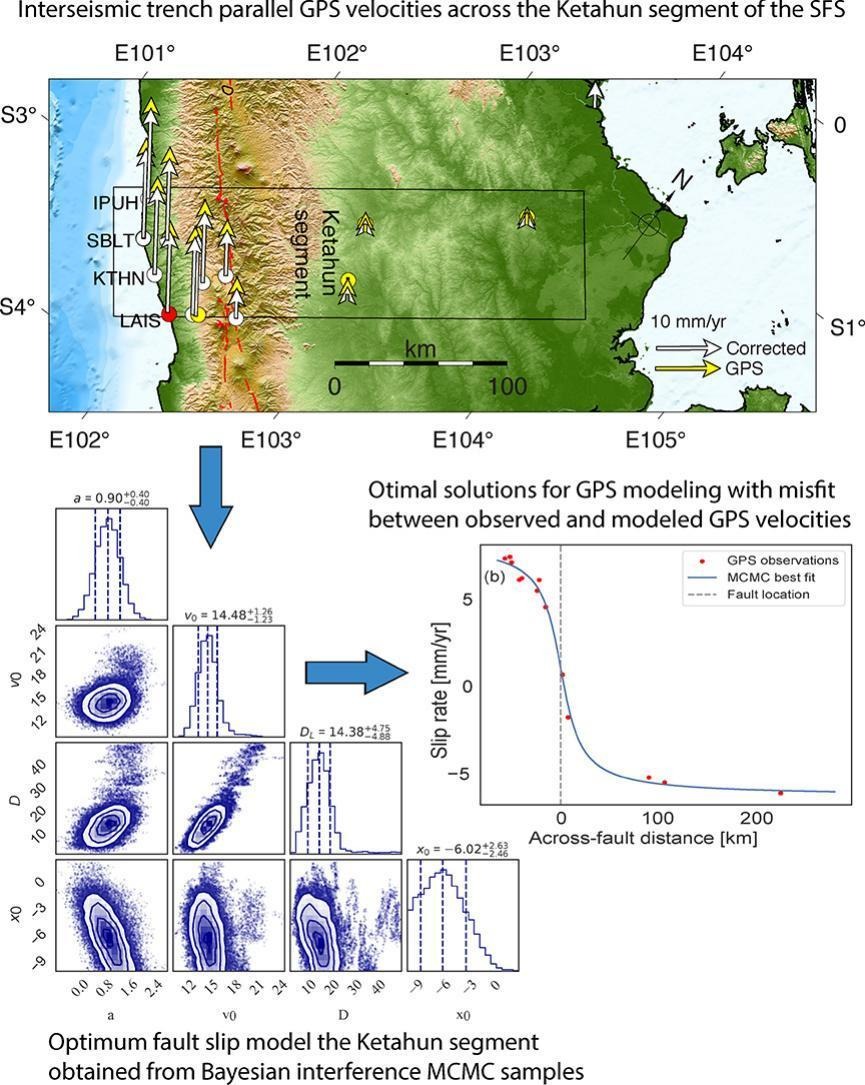
Present-day inter-seismic velocities and fault slip rate of Ketahun segment, Sumatran Fault System (SFS) inferred from Global Positioning System (GPS) observations

Ashar Muda Lubis, Rida Samdara, Rio Sahputra, Lina Handayani, Qiu Qiang, Agnis Triahadini, Muhammad Maruf Mukti, Oktadi Prayoga

Tectonophysics, Volume 914, 25 November 2025, 230879, https://doi.org/10.1016/j.tecto.2025.230879

Highlights

  • We modelled GPS data during 2018–2024 to estimate the slip rate and locking depth of Ketahun segment.
  • We find the importance of viscoelastic response and megathrust coupling effect in our analysis.
  • The Ketahun segment slip rate is 14.5 [−1.2, +1.3] mm/yr and locking depth of 14.4 [−4.9, +4.8] km.
  • The Ketahun segment is capable of generating a magnitude ∼6 to 7+ in the future.

Abstract

The Ketahun segment of the Sumatran Fault System (SFS) is distinctive and tectonically active segment, yet the slip rate of the segment is not widely known. The Ketahun segment underwent two major earthquakes of Ms 7.6 in 1946 and Ms 6.8 in 1952, respectively. Using Global Positioning System (GPS) data, we aim to better estimate the slip rates using a dislocation elastic model following a Bayesian approach with Metropolis Markov chain Monte Carlo (MCMC) samplers to estimate optimum fault parameters. Then we determined the potential amount of cumulative energy stored at the segment. We processed raw GPS data from 35 GPS stations, combining from GIA, SuGAr, and UNIB networks during 2018–2024 using GAMIT/GLOBK software. The daily GPS solutions were constrained into the ITRF-2014 frame, and the GPS velocities were translated into Sunda block. Before we model the trench parallel GPS velocities, we attempted to correct the viscoelastic velocities due to the 2007 Mw 8.4 Bengkulu earthquake incorporating the effect of megathrust coupling on the trench parallel GPS velocities. We find the importance of viscoelastic response and megathrust coupling effect in our analysis, providing better slip rate and locking depth estimation. Our result inferred that the estimated fault slip rate is 14.5 [−1.2, +1.3] mm/yr with a locking depth of 14.4 [−4.9, +4.8] km across in the Ketahun segment. The segment is capable of generating a magnitude ∼6 to 7+ if a single earthquake occurs every 50 to 200 years.

Read article at publisher

Update daftar publikasi

Ini adalah update publikasi kami sampai pertengahan tahun ini. Semoga bermanfaat. Salam.


Godang, S., Saputro, S. P., Li, H., Satyana, A. H., & Srichan, W., 2025. Geochemistry of the Adang volcanics in Western Sulawesi: Unveiling the tectonic evolution of the opening of the makassar strait. Solid Earth Sciences, 10(1), 100228. https://doi.org/10.1016/j.sesci.2025.100228 (open access) [link] [pdf]

Handayani, L., Mukti, M. M., Arisbaya, I., Gaol, K. L., Sudrajat, Y., Lubis, A. M., & Anggono, T., 2025. Basement structure across Renun segment near Toba caldera inferred from the gravity anomaly: Implication for potential earthquake rupture barrier. Geodesy and Geodynamics. https://doi.org/10.1016/j.geog.2025.04.006 (open access) [link] [pdf]

Ramdhan, M., Palgunadi, K. H., Mukti, M. M., Librian, V., Daniarsyad, G., Muttaqy, F., … & Febriani, F., 2025. Aftershock sequence of the Yogyakarta earthquake 2006 (Mw~ 6.4), Indonesia, based on analysis of hypocenter relocation, static, and dynamic stress. Natural Hazards, 1-21, https://doi.org/10.1007/s11069-025-07440-8 [link] [pdf]

Ramdhan, M., Priyobudi, P., Mukti, M. M., Putra, A. S., Hidayat, E., Muttaqy, F., Syuhada S.,
Hanif, M., Widiyantoro, S., Librian, V., Susilawati, A., Madrinovella, I., & Wandono, W., 2025. Tracing fault systems from subsurface to surface in Yogyakarta and its surroundings, Indonesia. Natural Hazards Research, https://doi.org/10.1016/j.nhres.2025.07.003 (open access) [link] [pdf]

Satyana, A.H., (2025). Natural hydrogen systems in various geotectonic settings of Indonesia: Bottom–up approach. Indonesian Petroleum Association Forty-Ninth Annual Convention & Exhibition [link] [pdf]

Satyana, A.H., 2025. Paleogene to Neogene Volcanisms of Eastern Margin of
Sundaland: Petrotectonic Evolution and its Implications to Petroleum Exploration in the Makassar Strait, South Arm of Sulawesi, and Bone Basin. Indonesian Petroleum Association Forty-Ninth Annual Convention & Exhibition [link] [pdf]

Syuhada, S., Muttaqy, F., Anggono, T., Pranata, B., Puspito, N.T., Ramdhan, M., Febriani, F., Mukti, M.M., Dewi, C.N., Hasib, M. and Prasetio, A.D., 2025. Spatial variation of crustal anisotropy in Simeulue Island, Indonesia, from shear wave splitting analysis. Physics of the Earth and Planetary Interiors, p.107362. https://doi.org/10.1016/j.pepi.2025.107362 [link] [pdf]


Untuk melihat semuanya, klik di sini.

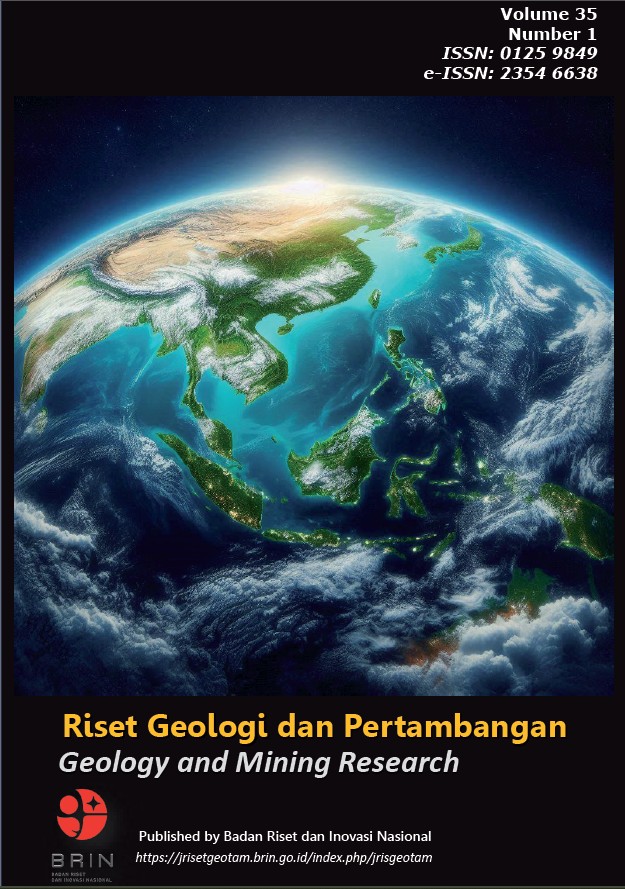
Riset Geologi dan Pertambangan Volume 35 No 1 (2025)

Cover Page

Dear RGP readers,


We are delighted to deliver the first issue of Volume 35 of Riset Geologi dan Pertambangan (Geology and Mining Research). This issue publishes five papers dealing with seismic hazards, tectonic geomorphology, and granite mineralogy. Hermawan et al. present their work on distribution of PGA values on bedrock in central Java area using Probabilistic Seismic Hazard Analysis. They further suggest that there is a necessity in earthquake mitigation to minimize losses when a major earthquake occurs in the future. The second article by Fahrezi et al. describes seismic hazard
evaluation using seismic response analysis in Bengkulu area. In the third article, Maryudhaningrum et al. elucidate the role of groundwater extraction and natural consolidation to land subsidence in Bandung Basin.

The fourth article by Faturrakhman et al. presents a new insight into hydrogen exploration by using tectonic geomorphology to identify key target areas based on their tectonic activity in relation to the occurrence of active faults in central Sulawesi area. Whereas, the last paper by Elly et al. is dealing with new petrography and X-ray diffraction data of granite from Hukurila area that contributes in understanding granite petrogenesis in Ambon, eastern Indonesia.

We acknowledge the authors and reviewers for their valuable works and contributions to this issue. Many thanks to the editorial members and staffs for their continuous support for the publication of this first issue of this year. We welcome your scientific contributions for the next upcoming issues.

Sincerely,
The Editors of RGP

Riset Geologi dan Pertambangan is now indexed in Scopus

We are excited to share that our journal, Riset Geologi dan Pertambangan is now indexed in Scopus and ranked by the SCImago Journal & Country Rank (SJR)

Riset Geologi dan Pertambangan (Geology and Mining Research) is a gold open-access journal managed voluntarily by Earth science enthusiasts, supported, and published by BRIN Publishing (ISSN 0125-9849, e-ISSN 2354 6638). We believe that Earth science research should be inclusively accessible for everyone. There is no fee to submit manuscripts and no cost to read our peer-reviewed articles.

Our journal publishes research papers, reviews, and short communications in geosciences-related interdisciplinary topics. We are pleased to invite researchers and practitioners in these fields to contribute to the journal by sharing their research, insights, and perspectives. 

Riset Geologi dan Pertambangan Volume 34 No 2 (2024)

Dear RGP readers,

We present the second issue of Volume 34 of Riset Geologi dan Pertambangan (Geology and Mining Research). This second issue publishes five papers dealing with engineering geology, geological resources, sedimentary geology, and hydrogeology. In the first article, Dzaki et al. present landslide susceptibility zone using the weight of evidence method in the south of Yogyakarta. Their landslide susceptibility map shows that the research location is predominantly characterized by areas with medium to high susceptibility to landslides. Furthermore, the medium and high susceptibility zones are situated close to the rivers that related to the alignment of faults.

Kamal et al. discuss modelling a two-dimensional map of soil parameters in Bengkulu based on research points strategically distributed throughout the city. The parameters include shear wave velocity, cone resistance, and corrected standard penetration test. The research points represent the diverse soil conditions in the area, making the modelled soil parameters useful for planning construction.

The third article by Solihin et al. briefly reviews different aspects of nickel ore, such as its history, types, distribution, demand, and the technology used for mining and processing it. Indonesia has significant nickel ore deposits, primarily in the form of laterite, due to its tropical climate with high temperatures and rainfall. The authors also discuss advanced materials made from laterite ore, including photocatalysts and batteries.

In the fourth article, Anhaer et al. clarify sedimentary facies and sedimentation mechanism of volcaniclastics of Cikarang Member of Jampang Formation in southern part of Bogor Trough. They measured stratigraphy of the rock units supported by petrographic analysis and paleontological analysis. The rock units consist of 11 lithofacies deposited in inner-middle fan with changes in depositional sub-environment variations of channels, sandy lobes, silty-sandy distal lobes, and proximal levees. The volcaniclastics are deposited by turbulent current with various cohesive debris flows.

The last paper by Nugraha et al. evaluates the performance of the Krylov Subspace method with adaptive preconditioning compared to classical iterative methods, such as Gauss-Seidel, Jacobi, and Successive Over-Relaxation (SOR), in the simulation of steady-state groundwater flow on a 2D grid. They conclude that the Krylov Subspace method with adaptive preconditioning is the best solution for applications that require high efficiency in groundwater flow computing.

We sincerely acknowledge all the authors and reviewers for their valuable contributions to this issue. We recognize all the editorial members and staffs for their continuous fineness support for the publication of this volume. Happy new year and we wish all of you a successful continuation in scientific work and
achieving interesting results of scientific research in the coming year, all the best!

The Editors of RGP


Read this volume here or at publisher.

The origin of Baribis Fault and its relationship to the dynamics of Sunda Arc

Based on analyses of published geological cross sections along the Baribis Fault, we briefly review several possible mechanisms of this backarc thrust that developed behind the volcanic arc in western Java. There is no general agreement regarding the mechanisms of the backarc thrust. Therefore, the origin of this fault remains uncertain. Previous works proposed that the backarc thrust in western Java may have developed as deformation of paleo-accretionary wedge sediments behind a continental backstop, inverted normal fault, northward migrating thrust belt, and thrusting due to gravitational sliding of the volcanic arc. However, evidences supporting those mechanisms still need to be elucidated. Detailed examination of the available geological data might suggest that backarc thrusting in western Java may have formed due to stress transfer through rigid arc blocks. The far-field stress from the subduction zone is propagated through remnants and modern volcanic arcs and finally, deformed sediments in the Bogor Trough that nucleated as backarc thrust.

Authors:

Hanief Ajib Abdalla, Nasywa Dhia Khalifa, Cyntia Adrian Lestari, M. Maruf Mukti, Akhmad K Gibran, Fadlin


Read pdf here or at publisher

Riset Geologi dan Pertambangan Volume 34 No 1 (2024)

Dear RGP readers,


We present the first issue of Volume 34 of Riset Geologi dan Pertambangan (Geology and Mining Research). This issue publishes five articles that covered topics on hydrogeology, mining, petrology, and geochemistry. In the first article, Mareta et al. present the water critically index of Welaran area in Central Java, Indonesia. The higher the WCI value, the more concerned the water conditions in the area will be. The water crisis can be handled if various parties manage water resources following good management. The Welaran area is part of the Lukulo Watershed, where the population often experiences water shortages. In 2020, Karangsambung has been designated as a part of Kebumen Global Geopark, which will certainly increase the number of tourists visiting here. The increase in tourist visits will also increase the need for water, including in the Welaran Watershed. The second article by Kasih et al. briefly explained mine drainage system design in a coal mine in Kalimantan, Indonesia. This mine drainage system aims to ensure that mining activity areas are not flooded during the rainy season. The drainage system consists of designing sump dimensions, open
channels, settling ponds, and pumping and piping systems. In the third paper, Al Kausar et al. elucidate geochemical analysis, including major, trace and rare earth
elements, conducted by fusion ICP-MS to find out the different composition of volcanic rocks in the Karaha-Talagabodas fields in West Java, Indonesia. The major element diagram shows the sampled rocks consist of calc-alkaline for andesite of Karaha and basalt, basaltic andesite, and andesite of tholeiitic environments for the Talagabodas volcanic rocks. The normalized REE diagram of N-MORB shows the similarity of the pattern of all Talagabodas volcanic rocks, whereas the Karaha andesite rocks show
slight REE enrichment and europium depletion. The next article investigates the possibility of using flotation process wastes from Buzlukdağı feldspar beneficiation plant, Türkiye as an alternative raw material. Ozgul & Ozcelik evaluate the use of wastes from feldspar enrichment and feldspar processes as alternative raw materials in another process and investigating their usability as a final product in various sectors and fields. The results show that the process can be used for technological purposes. Furthermore, the wastes from the enrichment can be used to provide permeability in urban waste storage areas and hydroelectric dam construction.
In the last paper, based on analyses of published geological data, Abdalla et al. reviewed several possible mechanisms of this backarc thrust in western Java. Previous works proposed that the backarc thrust in western Java may have developed as deformation of paleo-accretionary wedge sediments behind a continental backstop, inverted normal fault, northward migrating thrust belt, and thrusting due to
gravitational sliding of the volcanic arc. However, evidences supporting those mechanisms still need to be elucidated.


Riset Geologi dan Pertambangan – Geology and Mining Research welcomes your contributions in the forthcoming issues. We sincerely acknowledge all the authors and outstanding reviewers for their valuable contributions to this issue. We recognize all the editorial members and staffs for their continuous fineness support for the publication of this volume.
The Editors

Exploring natural hydrogen and abiotic methane in Indonesia: Case and idea from Tanjung Api gas seeps, East arm of Sulawesi – building a geologic hydrogen system in a collision zone (Satyana, 2024)

Read [pdf] or back to [Publikasi kami]